Client project · Clinical AI tool
AI Cephalometry
From an hour of tracing to a quick check.
A cephalometric analysis tool for an orthodontic practice. It finds 25 landmarks on a side-profile X-ray, draws the planes and angles and calculates the full Belgrade 2020 protocol in seconds. The orthodontist checks the result and decides.
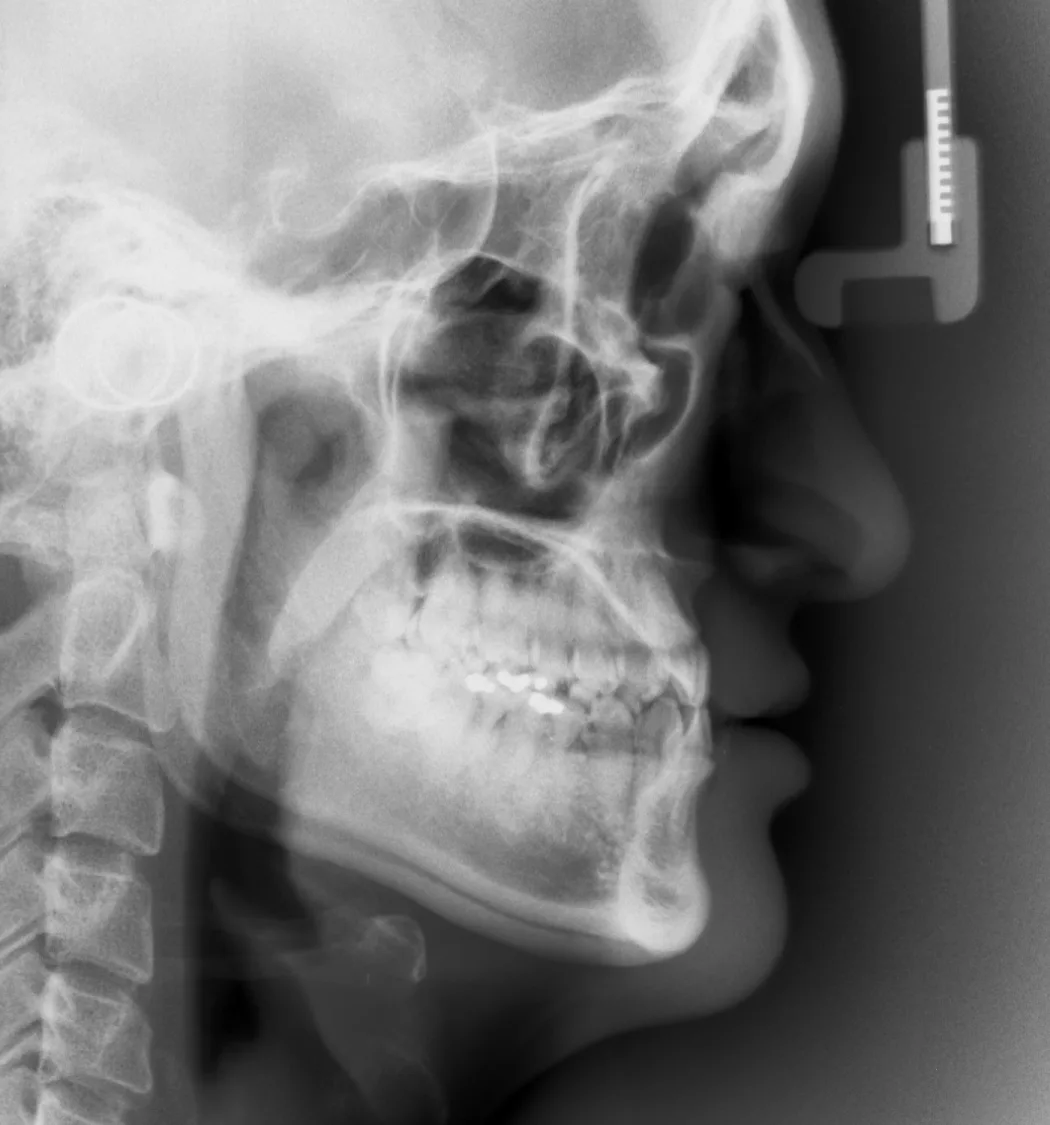
What the tool returns
18 of 47 measurements, Belgrade 2020 protocol
Skeletal Class III
ANB −5.1°, Wits −5.4 mm
Horizontal growth pattern
Björk sum 385°, S-Go/N-Me 72%
| SNA | Below norm: 75.9° | Norm 80–84 |
|---|---|---|
| SNB | Within norm: 80.9° | Norm 78–82 |
| ANB | Below norm: −5.1° | Norm 1–5 |
| Wits (AO–BO) | Below norm: −5.4 mm | Norm 0–4 |
| SN/PP | Above norm: 12.4° | Norm 5–11 |
| SN/MP | Below norm: 25.2° | Norm 26–30 |
| PP/MP | Below norm: 12.8° | Norm 15–25 |
| FMA | Below norm: 15.1° | Norm 22–28 |
| U1/PP | Above norm: 122.5° | Norm 104–116 |
|---|---|---|
| IMPA | Below norm: 81.4° | Norm 85–91 |
| FMIA | Above norm: 83.5° | Norm 64–70 |
| N-S-Ar | Within norm: 125.8° | Norm 118–128 |
|---|---|---|
| S-Ar-Go | Within norm: 140.9° | Norm 137–149 |
| Ar-Go-Me | Below norm: 118.6° | Norm 123–137 |
| Björk sum | Below norm: 385.2° | Norm 392–400 |
| S-Go / N-Me | Above norm: 72.3 % | Norm 62–65 |
| Upper lip to E-line | Below norm: −6.8 mm | Norm −4 to 3 |
|---|---|---|
| Lower lip to E-line | Below norm: −3.2 mm | Norm −2 to 4 |
▲ Above norm● Within norm▼ Below norm
Public research X-ray (ISBI 2015 challenge, image 166, CC BY 4.0), not a patient of the practice. The tool’s points sit 0.95 mm on average from two experts’ annotations on this image. The orthodontist reviews every point; the tool supports her decisions and does not diagnose.
What we built
01
A landmark model trained for the job
A neural network (U-Net with a ResNet-34 encoder) trained on 1,400 annotated X-rays from public research datasets. It places 25 landmarks in one to two seconds. On the ISBI 2015 benchmark its points sit 1.03 mm from expert annotations on average, in line with published research; general-purpose vision models miss by 5 to 20 mm on the same images.
02
Her protocol, measured automatically
47 measurements from the Belgrade 2020 protocol, including her own conventions, calculated live as points move. Values outside the norm are flagged, and the tool summarises skeletal class and growth pattern.
03
Built to be checked
Suggested points stay marked until she confirms them, and points where the network and Claude disagree are flagged to check first. Drag, nudge by the pixel, undo.
04
Report and assistant
A printable PDF report, saved analyses she can reopen, and an assistant (Claude) that discusses the current analysis with her without ever seeing the patient’s name.
The workflow
Upload the X-ray → straighten and calibrate it → the model places the landmarks → the orthodontist checks and adjusts → measurements, interpretation and the PDF report are ready. The tool supports her decisions; it does not diagnose.
What this delivers
The orthodontist reports that an analysis that used to take 45 minutes to an hour is now ready in seconds. She only checks the points and very rarely needs to move one. Every number and parameter is there at once, which gives her time back for her patients.
The idea to take away
In a specialist’s work, AI earns its place by removing the manual hour before the decision, not the decision itself. Train on the right data, follow the expert’s own method, and make checking fast.